



SEO Audit Services India: The Complete 2026 Growth Guide
Most websites that stall in Google are not missing effort. They are missing a diagnosis. Owners keep publishing blogs, buying links and tweaking titles, while the actual blockers sit in crawl budget, duplicate templates or a slow product page nobody has opened in Search Console. That is exactly the gap SEO audit services India businesses buy are meant to close: a structured, evidence-based review of why your site is not ranking, and a fix list ordered by revenue impact instead of guesswork.
Related: our SEO services in Hyderabad.
This guide explains what a credible website SEO audit covers in 2026, what it should cost in India, how to read the report you receive, and what to do in the 90 days after it lands.
What SEO Audit Services Actually Cover in 2026
A serious audit is not a one-click tool export. Tools generate the raw signal. A consultant decides what matters. A complete engagement usually spans four layers.
1. Technical crawl and indexation
- Crawlability: robots.txt rules, orphan pages, redirect chains, broken internal links
- Indexation: pages excluded by Google, duplicate URLs, canonical conflicts, parameter bloat
- Core Web Vitals: LCP, INP and CLS measured on real user data, not just lab scores
- Structured data: Organization, LocalBusiness, Product, Article and FAQ schema coverage
- Site architecture: click depth, internal link equity, and whether money pages sit too deep
2. On-page and content quality
Every indexable page is mapped to a keyword and an intent. The audit flags cannibalisation where three pages fight for one term, thin pages that add no value, missing or duplicate title tags, weak heading structure, and content that answers a question less completely than the pages currently outranking you.
3. Off-page and authority
A backlink review looks at referring domain quality, anchor text distribution, toxic or paid link exposure, and the gap between your profile and the three competitors who consistently outrank you. For local businesses this extends into citation consistency and Google Business Profile health.
4. Analytics and measurement
Plenty of Indian sites have broken tracking: duplicate GA4 tags, conversions that never fire, Search Console properties missing half the domain variants. If measurement is wrong, every decision after it is wrong too.
Why 2026 Audits Look Different
The biggest shift is that Google is no longer the only surface that reads your site. AI Overviews, chat assistants and answer engines now summarise content before a user ever clicks. That has pushed generative engine optimisation into standard audit scope.
Practically, a 2026 audit adds three checks that did not exist a few years ago:
- Answer extractability: is your content structured in clear question and answer blocks that a model can quote accurately?
- Entity clarity: does your site state who you are, where you operate and what you sell in machine-readable schema, so you are recognised as a real entity?
- Citation readiness: do you publish original data, pricing or process detail that an AI summary has a reason to reference?
What a Real Audit Report Should Contain
Ask to see a redacted sample before you pay. A report worth its fee always includes:
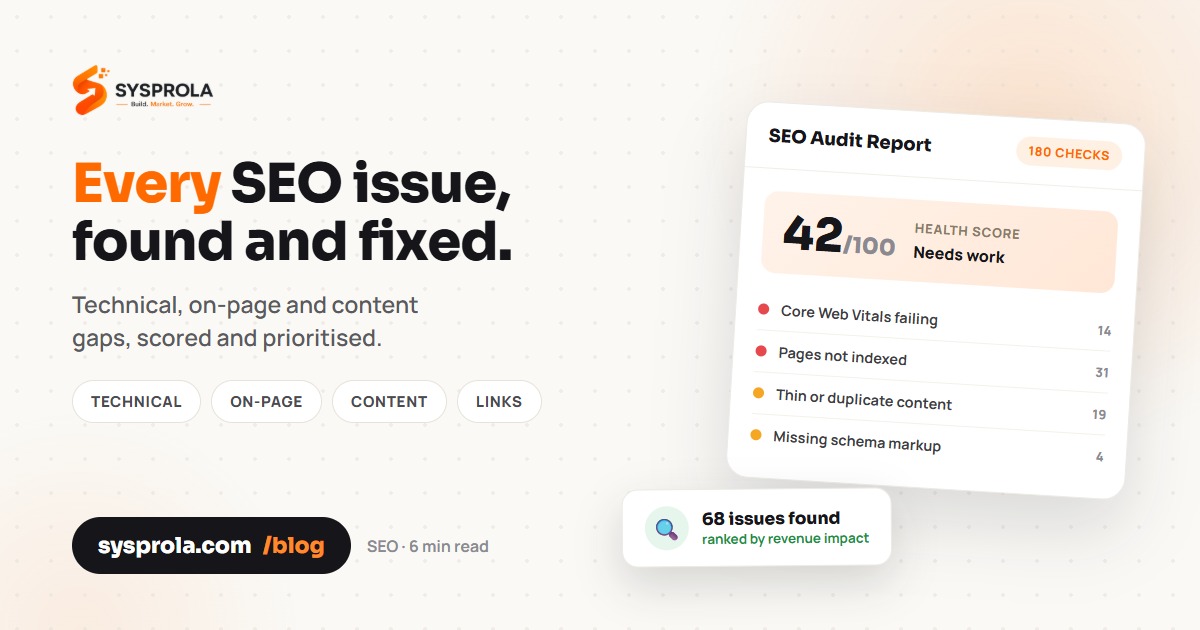
- An overall health score with the methodology behind it, not a vanity number
- Every issue tagged by severity and by estimated business impact
- A prioritised fix list split into quick wins, developer tasks and content work
- Screenshots or exports as evidence for each claim
- Effort estimates so your team can actually schedule the work
- A walkthrough call where the consultant defends the findings
The last point matters most. A PDF with 200 flagged issues and no ranking is a data dump, not an audit. What you are buying is judgement about which 12 things to do first.
SEO Audit Pricing in India
Rates vary widely, and the spread usually reflects depth rather than quality of writing.
- Rs 10,000 to Rs 25,000: a focused audit for a small brochure site, typically 20 to 40 pages, technical and on-page only
- Rs 25,000 to Rs 60,000: a full audit for a mid-size business or service site, including competitor and backlink analysis
- Rs 60,000 to Rs 1,50,000 plus: enterprise or large eCommerce catalogues, log file analysis, faceted navigation review and migration planning
Anything sold for a few thousand rupees is almost always an unedited tool export. It will list issues but will not tell you which ones cost you money. Timelines are typically 2 to 3 weeks for a mid-size site.
How to Choose an SEO Audit Partner
Look for these signals of a genuine specialist:
- They ask for Search Console, GA4 and crawl access before quoting
- They name the tools they use and explain what those tools cannot see
- They talk about revenue and lead quality, not just keyword counts
- They offer implementation support, or a clear handover to your developer
Walk away from anyone guaranteeing a number one ranking, quoting before seeing the site, or refusing to explain their scoring. Those are the same red flags that show up across digital marketing services generally, and they are easy to spot once you know to look.
What to Do in the 90 Days After the Audit
An audit only pays back when it is executed. A sensible sequence looks like this:
- Weeks 1 to 2: fix indexation blockers, broken redirects and tracking errors. These are cheap and immediate.
- Weeks 3 to 6: ship Core Web Vitals work, schema markup and internal linking changes with your development team.
- Weeks 6 to 12: consolidate cannibalising pages, rewrite thin money pages, build the missing content, then re-crawl against the original baseline.
Re-auditing every 6 to 12 months keeps the gains. Sites drift. Plugins update, developers ship new templates, and old issues quietly return.
Frequently Asked Questions
How long does an SEO audit take to complete?
A small site of 20 to 40 pages usually takes 5 to 7 working days. A mid-size business site takes 2 to 3 weeks, and a large eCommerce catalogue with log file analysis can run 4 weeks or more. The crawl itself is fast. What takes time is the manual review, competitor benchmarking and building a fix list your developers can actually action without further clarification.
How much do SEO audit services in India cost?
Expect roughly Rs 10,000 to Rs 25,000 for a small site, Rs 25,000 to Rs 60,000 for a mid-size business site with competitor and backlink analysis, and Rs 60,000 upward for enterprise or large catalogue sites. Pricing tracks page count, catalogue complexity and whether implementation support is bundled in. Very cheap audits are almost always raw tool exports with no prioritisation.
Is a free SEO audit tool good enough?
Free tools are useful for a first look and will surface obvious problems like missing titles or slow pages. What they cannot do is judge intent, spot keyword cannibalisation, evaluate content depth against competitors, or tell you which of 200 flagged issues will actually move revenue. Use them to decide whether you need a paid audit, not as a replacement for one.
How often should a website be audited?
Once every 6 to 12 months suits most businesses, with a lighter quarterly health check on crawl errors and Core Web Vitals. Audit immediately outside that cycle if you migrate domains, redesign the site, replatform your store, or see a sudden traffic drop. Algorithm updates and unnoticed developer changes are the two most common causes of silent decline.
Will an audit alone improve my rankings?
No. An audit is a diagnosis, not a treatment. Rankings move only when the recommendations are implemented, and most of the gains come from the top 10 to 15 fixes rather than clearing the whole list. Budget for execution time from your developer and content team, or hire the audit partner to implement, otherwise the report sits unused.
Should I hire a local agency or a freelancer for an audit?
A freelancer works well for a small site and a tight budget. For a business site with development dependencies, an agency is usually better because the same team can audit, fix and measure without handover friction. Many Indian businesses shortlist a best digital marketing agency in Hyderabad for exactly this reason, since audit plus implementation under one roof removes the gap where recommendations go to die.
Related topics
Ready to grow? Get a free consultation from Sysprola today.