

eCommerce SEO Services India: The 2026 Growth Guide
Investing in the right eCommerce SEO services India online stores can grow on is the highest-leverage decision a D2C brand or retailer will make in 2026. With the Indian e-commerce market on track to cross ₹7.5 lakh crore and around 900 million people now online, organic search has become the one channel that compounds - bringing buyers to your product pages long after the ad budget runs out. Done right, eCommerce SEO builds a moat that paid acquisition can never replicate.
This guide covers what eCommerce SEO really involves, the technical foundations that matter most, realistic timelines, and how to choose a partner who grows revenue - not just rankings.
Why eCommerce SEO Is Different
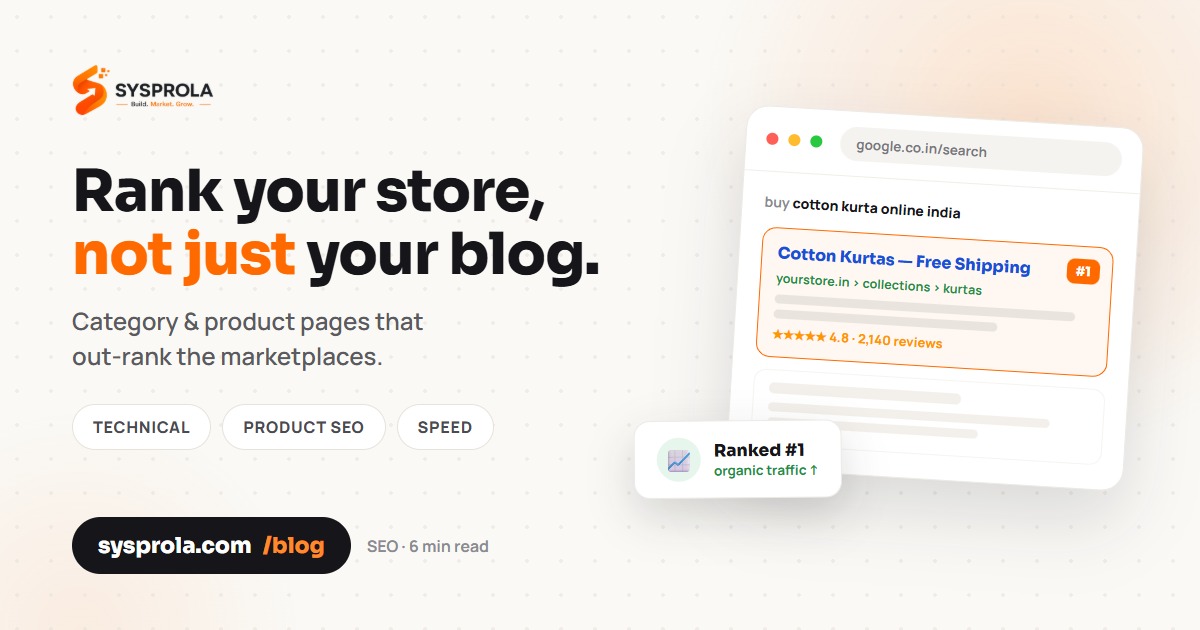
Ranking an online store is not the same as ranking a blog. You are dealing with hundreds or thousands of product and category pages, constant inventory changes, faceted navigation, and fierce competition from Amazon, Flipkart, Meesho, Myntra, and Nykaa. Good eCommerce SEO services solve problems that content-only SEO never touches:
- Optimising category pages - often your biggest revenue drivers - for high-intent buying keywords.
- Handling product-page SEO at scale with templated titles, descriptions, and schema.
- Fixing technical issues like duplicate content, thin pages, and crawl waste from filters.
- Building topical authority through buying guides and comparison content.
The Technical Foundation That Ranks Stores
Before content or links, your store needs a clean technical base. The essentials for 2026:
- Site speed & Core Web Vitals - with India's search market roughly 75% mobile, a slow store loses both rankings and sales. Aim for sub-2-second loads.
- Crawlability & indexation - ensure Google finds your money pages and ignores infinite filter URLs.
- Structured data - Product, Review, Breadcrumb, and FAQ schema win rich results and click-through.
- Clean site architecture - a logical hierarchy from home → category → subcategory → product spreads authority efficiently.
- Mobile-first UX - because the overwhelming majority of Indian shoppers browse and buy on their phones.
Content and Keyword Strategy for Indian Stores
Winning eCommerce SEO in India means matching how real shoppers search:
Target buying intent, not just volume
Optimise for terms like "buy [product] online India" and "[product] price" that signal a ready-to-purchase shopper, then support them with informational guides that capture earlier-stage demand.
Plan for regional and multilingual search
By 2026, roughly half of Indian internet users consume content in regional languages. Brands that optimise for Hindi, Telugu, Tamil, and other languages reach demand their English-only competitors miss entirely.
Build trust signals
With cash-on-delivery still driving around 60% of transactions in Tier-2 and Tier-3 cities, clear return policies, reviews, and social proof directly influence both rankings and conversions.
What eCommerce SEO Costs and How Long It Takes
SEO is an investment that compounds, not a switch you flip. A realistic frame for the Indian market:
- Timeline - expect early movement in 2-3 months and meaningful organic revenue growth in 6-9 months.
- Pricing - managed eCommerce SEO retainers typically range from ₹25,000 to ₹1,00,000+ per month depending on store size and competition.
- ROI - because organic traffic doesn't carry a per-click cost, the return keeps climbing as rankings mature.
How to Choose an eCommerce SEO Partner
Use these filters when shortlisting eCommerce SEO services India providers:
- They audit your technical health and category structure before promising rankings.
- They report on organic revenue and assisted conversions, not just keyword positions.
- They understand your platform - Shopify, WooCommerce, or Magento - and its SEO quirks.
- They plan for scale: templates and automation for thousands of products, not one page at a time.
Why Sysprola for eCommerce SEO
At Sysprola, we combine deep technical SEO with a revenue-first mindset. We fix the crawl and speed issues holding your store back, optimise your highest-value category and product pages, and build the content and authority that keep you ranking above marketplaces. Every decision maps back to one number: organic revenue. That's how we help Indian online stores turn search into their most profitable, most durable growth channel.
Frequently Asked Questions
What is eCommerce SEO and why does it matter for online stores in India?
eCommerce SEO is the practice of optimising product pages, category pages, and site architecture so your store ranks for high-intent shopping keywords. For Indian online stores it matters because organic search delivers buyers who are ready to purchase without the recurring cost of paid ads. A well-optimised catalogue compounds in value, bringing consistent traffic and revenue month after month.
How do I optimise product pages for search engines?
Write unique product descriptions that target the exact terms shoppers search, and never rely on manufacturer copy that appears on hundreds of other sites. Add descriptive titles, structured product schema, high-quality images with alt text, and genuine customer reviews. Keep URLs clean and ensure the page loads fast on mobile, since most Indian shoppers browse on phones.
How long does eCommerce SEO take to show results?
Most stores begin seeing measurable movement within three to six months, though competitive categories can take longer. Early wins usually come from fixing technical issues and optimising existing product pages that already have some authority. Sustained ranking growth depends on consistent content, quality backlinks, and a clean crawlable site structure, so treat it as a compounding investment.
What are the biggest technical SEO issues for eCommerce sites?
Duplicate content from filtered and faceted URLs is the most common problem, followed by thin category pages and slow load times. Out-of-stock product pages, broken internal links, and missing canonical tags also drain crawl budget and rankings. Fixing these foundations first often unlocks bigger gains than adding new content on top of a broken structure.
Should online stores use category pages or product pages to rank?
Category pages usually rank for broad, high-volume keywords like a product type, while individual product pages target specific model or brand searches. A smart strategy optimises both, using category pages to capture wide demand and product pages to convert precise buyer intent. Interlinking them well passes authority and helps search engines understand your catalogue hierarchy.
How do I choose an agency to handle eCommerce SEO?
Look for a partner with proven experience scaling product catalogues, transparent reporting, and a focus on revenue rather than vanity rankings. Ask for case studies showing traffic and sales growth for stores similar to yours. Working with the best digital marketing agency in Hyderabad means you get technical depth, content skill, and a team that understands Indian buyer behaviour under one roof.
Related topics
Ready to grow? Get a free consultation from Sysprola today.