

Digital Marketing for Real Estate India: 2026 Lead Playbook
Digital marketing for real estate India has stopped being a portal listing plus a hoarding on the ORR. Between 73 and 82 percent of Indian property buyers now research online before they ever book a site visit, and the average buyer touches somewhere between 7 and 14 digital touchpoints before filling in a single lead form. Search results, portal listings, Instagram reels, YouTube walkthroughs and a WhatsApp forward from a broker all sit between your project and a booking.
If you would rather have it done for you, look at our digital marketing services in Hyderabad.
The developers and brokers winning in 2026 are not the ones spending the most. They are the ones who understand that a property lead is not a purchase, it is the start of a 60 to 180 day consideration cycle, and they build their marketing to survive that timeline.
Why Most Real Estate Campaigns Waste Money
The typical failure pattern is consistent. A developer runs lead form ads, collects 400 leads in a month at an attractive cost per lead, hands the sheet to a sales team, and discovers that half the numbers are unreachable and most of the rest were never in the market. The cost per lead looked great. The cost per site visit was catastrophic.
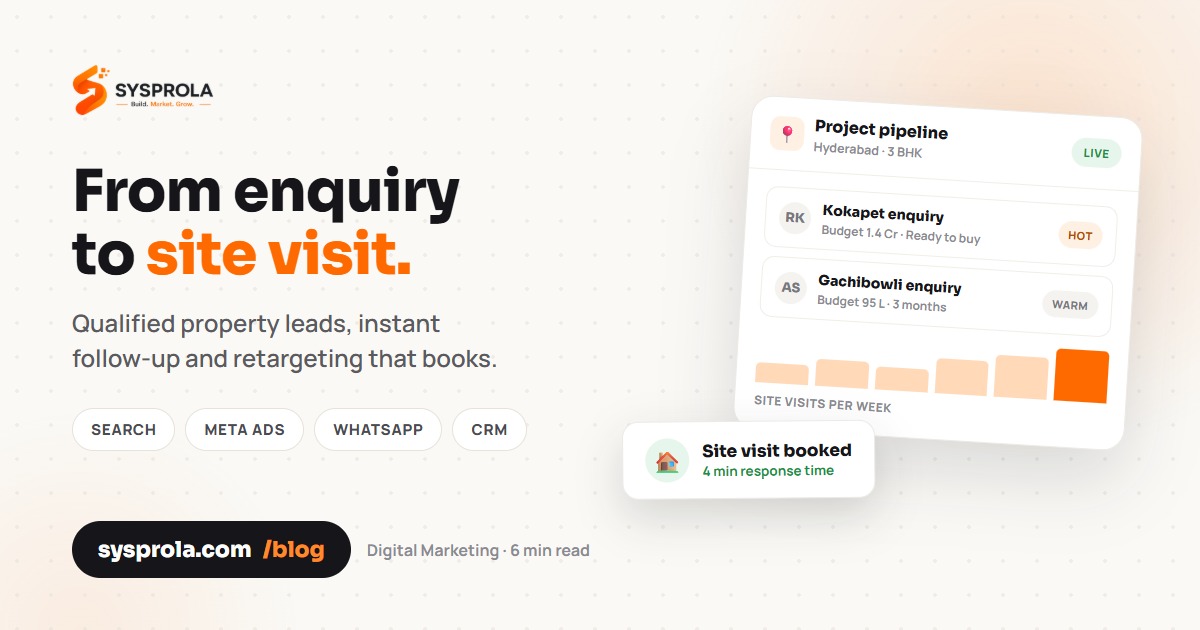
Three fixes address almost all of it. Qualify inside the ad, so budget and possession timeline are asked before the form submits. Route leads into a CRM within seconds rather than a daily spreadsheet, because response time is the strongest single predictor of whether a property lead converts. And measure cost per site visit, not cost per lead, because that is the only number connected to revenue.
The Channel Mix That Works for Indian Property
Search: Google Ads and SEO
Search captures people already looking. Bid on project names, locality plus configuration terms such as "3 BHK in Kokapet", and competitor project names where policy allows. Search leads cost more per lead than social but convert to site visits at a far higher rate because intent is already established. Alongside paid search, locality landing pages and a properly optimised Google Business Profile do steady work. Our guide to local SEO for real estate covers that side in depth.
Meta: Demand Creation at Scale
Instagram and Facebook create demand rather than capture it. This is where walkthrough reels, construction progress updates, amenity films and price-reveal creatives earn attention. Volume is high and cost per lead is low, but qualification must be tight or you will drown the sales team.
YouTube: The Trust Layer
Long-form project walkthroughs, locality tours and honest pros-and-cons videos do disproportionate work in real estate because the purchase is high risk. Buyers watch these before a site visit and again before signing. It is a slow channel that quietly shortens sales cycles.
Portals: Necessary, Not Sufficient
Magicbricks, 99acres and Housing deliver volume, but the leads are shared, price-shopping and heavily contested. Treat portals as one line item, never as the whole plan, and make sure your own channels are strong enough that a buyer who finds you on a portal can verify you independently.
WhatsApp and Retargeting
This is the highest-leverage and most neglected layer. Retargeting through Meta custom audiences, Google display remarketing and structured WhatsApp nurture typically contributes between 25 and 40 percent of eventual bookings. Budget at least 20 to 30 percent of paid spend to it. A buyer who saw your project in March and books in July was almost certainly reached by a retargeting sequence in between.
What Real Estate Leads Cost in 2026
- Affordable and mid segment, tier one metros: Rs 500 to Rs 2,000 per qualified lead.
- Premium projects, Rs 1.5 crore to Rs 3 crore: Rs 2,000 to Rs 3,500.
- Luxury above Rs 3 crore: Rs 3,500 to Rs 6,000 even with well-run campaigns.
- Cost per site visit: typically 8 to 15 times the cost per lead, which is why qualification pays for itself.
- Agency retainer: Rs 50,000 to Rs 3 lakh per month depending on project count and creative volume.
Early-stage developers commonly push up to 85 percent of their marketing budget into digital during launch phases, then rebalance toward brand and channel partner activity as inventory moves.
The Follow-Up System Matters More Than the Ads
A property lead that is not called within five minutes loses most of its value. Build the system before you spend the media budget:
- Instant lead capture into a CRM with automatic assignment to a sales executive.
- An automated acknowledgement over WhatsApp with the brochure and a booking link, sent within seconds.
- A defined call cadence, typically six attempts across 14 days at varied times of day.
- Lead scoring on budget, timeline and locality so the team works the best leads first.
- Site visit scheduling with automated reminders, because no-show rates run high.
- A long-term nurture track for buyers with a 6 to 12 month horizon rather than marking them lost.
Most developers we work with find their conversion problem lives here, not in the ad account. Fixing follow-up often produces a bigger lift than doubling the media spend.
RERA and Compliance in Your Marketing
Every advertisement for a registered project must carry the RERA registration number and the project's official web address. Ad platforms in India increasingly reject property creatives missing these details, and the reputational cost of misleading area or possession claims far outweighs any short-term lead gain. Keep carpet area, super built-up area and possession dates accurate across every asset, including reels and WhatsApp forwards, because inconsistencies surface fast in buyer groups.
Frequently Asked Questions
How much should a developer spend on digital marketing per project?
A common working range is 1 to 2 percent of projected gross sales value for the digital component, weighted heavily toward launch and toward the final inventory clearance phase. For a Rs 100 crore project that means roughly Rs 1 crore to Rs 2 crore across the sales cycle. Smaller brokers and channel partners typically operate at Rs 50,000 to Rs 2 lakh a month per active project.
Which channel gives the best quality real estate leads?
Google Search consistently produces the highest intent leads because the buyer is actively looking, and those leads convert to site visits at the best rate. Meta produces the highest volume at the lowest cost per lead but requires strict qualification. The strongest results come from running both and letting search capture the demand that social creates, rather than treating them as competing options.
Are property portals still worth the money in 2026?
Yes, as one channel among several. Portals deliver reliable volume and reach buyers in active comparison mode. The limitation is that leads are shared with competing projects and buyers arrive price-focused. Use portals for volume, and use your own search, social and retargeting stack to build the preference that makes a portal lead choose you over the four other developers who received the same enquiry.
How long does the real estate sales cycle actually take?
For mid segment residential, expect 60 to 120 days from first enquiry to booking. Luxury and plotted developments frequently run 6 to 12 months. This is why nurture matters so much: a lead marked dead at day 30 is often a buyer who simply had not finished comparing. Build campaigns and CRM stages around that reality rather than around a monthly reporting cycle.
Can digital marketing sell high-ticket luxury properties?
It can, but the mechanics differ. Lead volume drops sharply, cost per lead rises to Rs 3,500 and above, and the job shifts from generating enquiries to generating credibility. Long-form video, architectural detail, location storytelling and discreet retargeting outperform aggressive lead form pushes. Expect fewer, slower, better leads and measure accordingly. Working with the best digital marketing agency in Hyderabad for this segment usually means one that reports on site visits rather than form fills.
What CRM should a real estate business use?
The specific tool matters less than three capabilities: instant lead capture from every ad platform and portal, automatic assignment with response time tracking, and a nurture engine that can run WhatsApp and email sequences over months. Many Indian developers run purpose-built property CRMs, while others use a general CRM configured for long sales cycles. What kills performance is not the software choice, it is leads landing in a spreadsheet nobody opens until evening.
Related topics
Ready to grow? Get a free consultation from Sysprola today.