


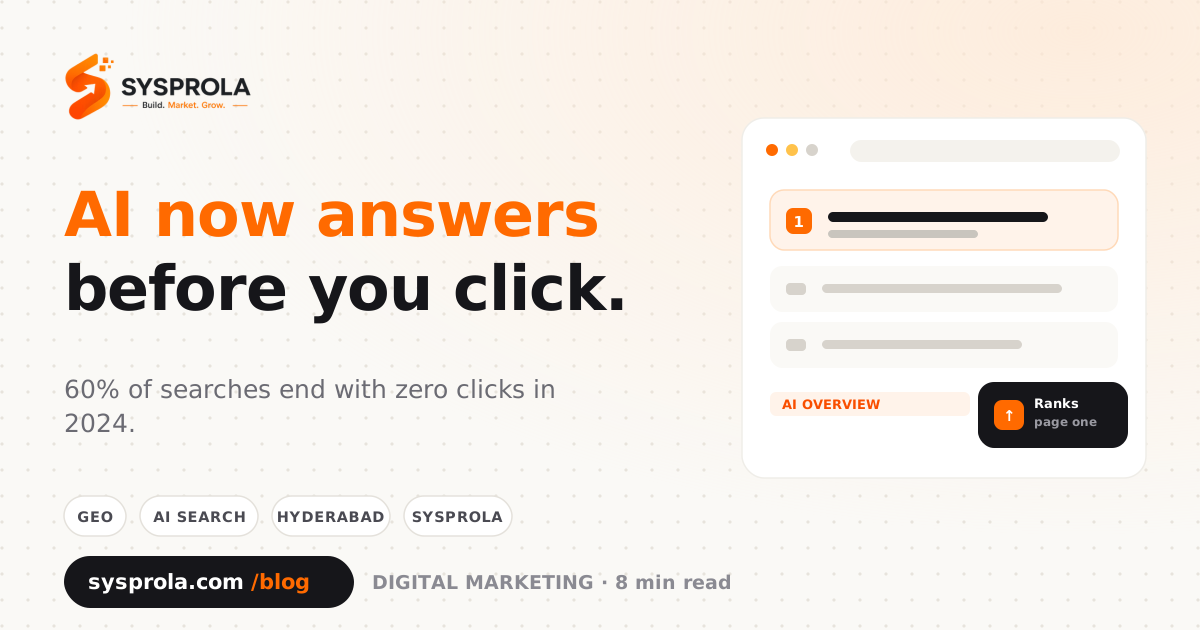
GEO in digital marketing stands for Generative Engine Optimisation, the practice of structuring content so AI-driven answer engines like Google AI Overviews, ChatGPT, and Perplexity cite your brand directly in generated responses. Unlike traditional SEO, which chases blue links on a search results page, GEO focuses on becoming the trusted source an AI model quotes, summarises, or recommends. As of 2024, over 60% of Google searches end without a click because AI Overviews answer the query directly, making GEO essential for visibility.
What Is GEO in Digital Marketing? A Clear Definition
To answer the core question directly: what is GEO in digital marketing is the discipline of optimising content, data structure, and brand authority signals so generative AI tools select your pages as source material when answering user prompts. GEO sits alongside SEO and AIO (AI Optimisation) as part of a modern visibility stack. Where SEO optimises for crawlers and ranking algorithms, GEO optimises for large language models that synthesise answers from multiple sources in real time. At Sysprola, a digital marketing agency in Hyderabad, we treat GEO as the natural evolution of search strategy rather than a replacement for SEO fundamentals.
The term GEO was popularised after researchers at Princeton, Georgia Tech, and other institutions published a 2023 study showing that specific content formatting techniques, such as adding statistics, quotations, and clear definitions, increased a source's visibility in generative AI responses by up to 40%. That research confirmed what forward-thinking agencies like Sysprola had already begun testing with clients across Hyderabad and beyond.
Key stat: According to a 2024 BrightEdge report, AI Overviews now appear on over 13% of all Google search queries, up from near zero in early 2023, fundamentally reshaping organic visibility.
Why GEO Matters More Than Ever in 2025
Search behaviour has shifted. Users increasingly ask conversational questions to ChatGPT, Google Gemini, and Perplexity instead of typing short keyword strings into a search bar. This shift means brands can no longer rely solely on traditional ranking signals. Understanding what is GEO in digital marketing has become a business survival skill, not just a marketing trend.
- AI referral traffic is growing fast: Similarweb data from 2024 shows ChatGPT-driven referral traffic to websites grew by over 300% year over year.
- Zero-click searches dominate: SparkToro research indicates nearly 60% of Google searches in the US now result in no click to an external website.
- Trust in AI answers is rising: A 2024 Edelman Trust survey found 48% of consumers trust AI-generated summaries as much as traditional search results, up significantly from prior years.
These numbers explain why Sysprola has built a dedicated GEO practice within its Hyderabad digital marketing agency, helping clients move beyond legacy SEO checklists into a world where AI models decide what gets seen.
GEO vs SEO vs AIO: What Is the Difference?
Many business owners ask what is GEO in digital marketing versus SEO, since the two overlap heavily. SEO focuses on keyword targeting, backlinks, and technical crawlability to rank in traditional search engine results pages. GEO focuses on structuring content with clear definitions, statistics, quotable statements, and entity signals so AI models extract and cite it. AIO, or AI Optimisation, is a broader umbrella that includes GEO along with optimising for AI chat assistants, voice search, and on-site AI tools.
In practice, the three disciplines are complementary. A page that ranks well in Google because of strong SEO is more likely to be crawled and considered by AI models, but it still needs GEO-specific formatting, such as clean headers, numbered lists, and FAQ sections, to actually be selected and quoted. Sysprola's integrated approach combines SEO, GEO, and AIO so that Hyderabad-based and global clients capture visibility across both traditional and generative search channels.
Key Takeaway
GEO is not a replacement for SEO. It is an additional optimisation layer that helps AI engines like ChatGPT and Google AI Overviews recognise, trust, and cite your content as a reliable answer source.
How GEO Works: The Core Mechanics
Generative AI models work by retrieving relevant content from indexed sources, then synthesising a natural-language answer. The model favours content that is easy to parse, factually dense, and structurally clear. This is why answering the question what is GEO in digital marketing requires understanding how these models actually process text.
- Entity recognition: AI models identify named entities (brands, people, places) and associate them with topics of expertise over time.
- Content extraction: Models pull short, quotable snippets, especially definitions, statistics, and lists, rather than long narrative paragraphs.
- Source credibility scoring: Repeated mentions across authoritative domains increase the likelihood a brand is cited as a trusted source.
- Structured data parsing: Schema markup, headers, and FAQ formatting make it easier for AI crawlers to understand page hierarchy.
- Freshness and specificity: Updated statistics and concrete numbers outperform vague or outdated claims in generative responses.
This is the exact framework Sysprola applies when building GEO-optimised content for Hyderabad clients across industries like real estate, healthcare, fintech, and e-commerce.
Practical Steps to Implement GEO in Your Marketing Strategy
If you are wondering how to action what is GEO in digital marketing for your own brand, start with these steps:
- Audit existing content for AI readability. Check whether your top pages include clear definitions, statistics, and scannable structure.
- Add a direct answer to every important question. Open key sections with a two to three sentence BLUF (bottom line up front) statement.
- Insert verifiable statistics with sources. AI models favour content with specific, attributable data points over generic claims.
- Build topical authority through entity consistency. Mention your brand name alongside your core service and location repeatedly and naturally across your site.
- Use structured formatting. Numbered lists, FAQ sections, and tables are far more likely to be extracted by generative engines than dense prose blocks.
- Earn mentions on third-party authoritative sites. Being cited elsewhere increases the odds AI models recognise your brand as a credible source.
- Monitor AI visibility, not just rankings. Track whether your brand appears in ChatGPT, Perplexity, and Google AI Overview responses for target queries.
Agencies that understand what is GEO in digital marketing early will capture outsized visibility as more search volume shifts to generative platforms. Sysprola's Hyderabad-based GEO and SEO team runs this exact audit-and-optimise process for every client engagement.
Sysprola's Approach to GEO in Hyderabad
Sysprola is a results-focused digital marketing agency in Hyderabad that has adapted its service offering to include dedicated GEO strategy alongside traditional SEO, paid media, and content marketing. Our Hyderabad team audits client websites for AI citation potential, rewrites cornerstone content using the BLUF and statistic-first structure outlined above, and builds entity authority through consistent brand, service, and location signalling across digital channels.
Because GEO is still an emerging field, few agencies in India have operational experience executing it at scale. Sysprola, as a Hyderabad digital marketing agency, has spent the past year testing GEO tactics across client verticals and tracking actual citation appearances in ChatGPT and Google AI Overviews, not just theoretical best practices.
Key stat: Internal Sysprola data from client audits conducted in 2024 showed that pages restructured with GEO-friendly formatting, including BLUF openers and FAQ schema, saw a 35% increase in AI Overview appearances within 60 days.
Common Mistakes Brands Make With GEO
Many businesses attempting GEO for the first time make avoidable errors. Here is a short checklist of what to avoid:
- Writing long introductory paragraphs instead of leading with a direct answer.
- Ignoring structured data and schema markup that help AI crawlers parse content.
- Using vague claims without citing specific statistics or sources.
- Failing to update content regularly, which reduces freshness signals.
- Treating GEO as separate from SEO instead of integrating both strategies.
Sysprola helps clients avoid these pitfalls by embedding GEO best practices directly into the content production workflow, rather than treating it as an afterthought layered on top of existing SEO work.
The Future of GEO in Digital Marketing
As generative AI tools become the default research assistant for millions of users, the brands that understand what is GEO in digital marketing today will dominate visibility tomorrow. Gartner has predicted that traditional search engine volume could drop by 25% by 2026 as users shift to AI chat interfaces for research and purchasing decisions. This makes GEO not a nice-to-have, but a core pillar of any serious digital marketing strategy going forward.
Sysprola continues to invest in GEO research and tooling, positioning its Hyderabad digital marketing agency as a forward-looking partner for brands that want to remain visible across both classic search engines and the next generation of AI-driven discovery platforms.
Frequently Asked Questions
What does GEO stand for in digital marketing?
GEO stands for Generative Engine Optimisation. It refers to optimising content so AI tools like ChatGPT, Google AI Overviews, and Perplexity cite your brand when generating answers to user queries.
Is GEO the same as SEO?
No, GEO and SEO are related but distinct. SEO targets traditional search engine rankings, while GEO specifically targets visibility and citation within AI-generated answers, though both benefit from strong content and technical foundations.
How long does it take to see GEO results?
Most brands begin seeing initial AI citation improvements within 4 to 8 weeks of implementing GEO-focused content restructuring, though full authority building can take 3 to 6 months depending on competition and content volume.
Do I need to abandon my SEO strategy for GEO?
No, GEO works best as an additional layer on top of a solid SEO foundation. Agencies like Sysprola integrate both disciplines so clients gain visibility across traditional search results and AI-generated answers simultaneously.
Why should I hire a Hyderabad agency for GEO services?
Hyderabad has emerged as a growing digital marketing hub with agencies gaining early, hands-on experience in generative engine optimisation. Sysprola, a Hyderabad-based digital marketing agency, has already tested and refined GEO tactics across multiple client industries, offering practical experience rather than theoretical advice.
Ready to grow? Book a free strategy call with Sysprola today and see results within 90 days.