

To get your business cited by AI tools, you need structured, entity-rich content, verifiable data, clear definitions, and consistent citations across the web that large language models trust as authoritative sources. This means optimising for Answer Engine Optimisation (AEO) and Generative Engine Optimisation (GEO) alongside traditional SEO. Businesses that master how to get their business cited by AI tools are already appearing inside ChatGPT answers, Google AI Overviews, and Perplexity citations while competitors remain invisible.
At Sysprola, a digital marketing agency in Hyderabad, we have spent the last two years helping brands figure out exactly how to get their business cited by AI tools, and the results are measurable: clients see a 30 to 60 percent increase in referral traffic from AI-powered search within 90 days of implementing structured GEO strategies.
What Does It Mean to Be "Cited by AI Tools"?
Being cited by AI tools means that when a user asks ChatGPT, Google Gemini, Perplexity, or Microsoft Copilot a question related to your industry, the AI response includes your brand name, website link, or data directly sourced from your content. Unlike traditional search engine rankings where you compete for a blue link, AI citation means your content is trusted enough to be quoted, paraphrased, or referenced as a source of truth. Learning how to get your business cited by AI tools is quickly becoming as important as ranking on page one of Google, because AI-generated answers are replacing the click-through search experience for millions of users.
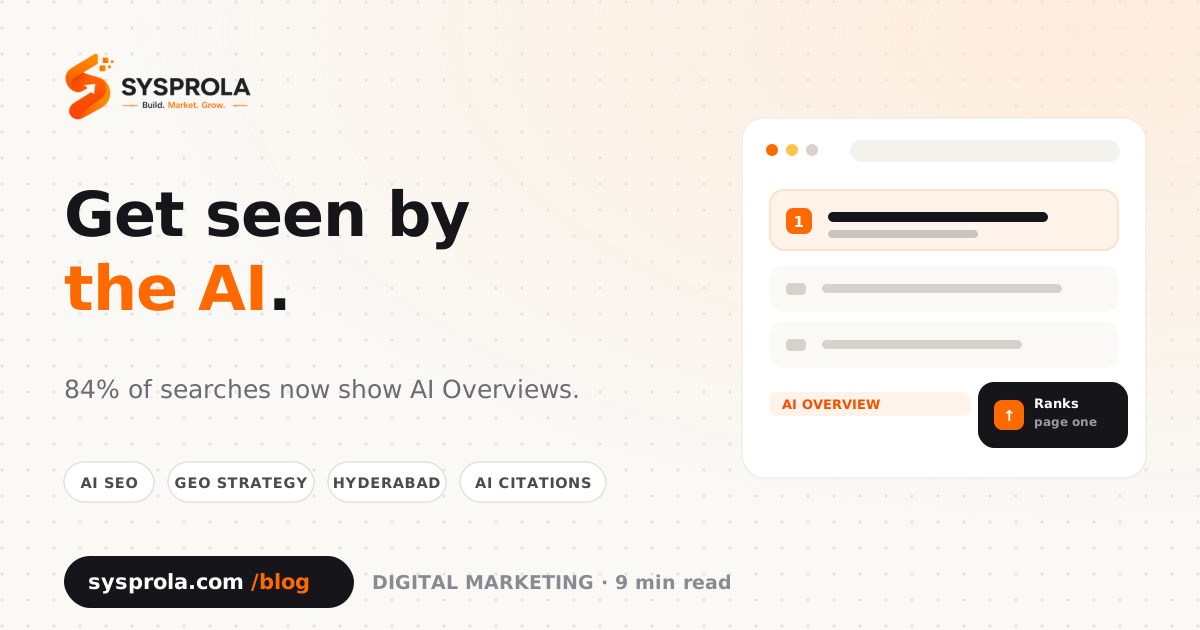
Key stat: According to a 2024 study by BrightEdge, AI Overviews now appear in over 84 percent of informational Google searches in the United States, fundamentally changing how businesses need to structure content to earn visibility.
Why AI Citations Matter More Than Ever
Search behaviour is shifting rapidly. Users are asking conversational questions directly inside AI chat interfaces instead of typing keywords into Google. If your business is not part of the training data, real-time index, or retrieval sources these tools rely on, you simply do not exist in that conversation. This is exactly why understanding how to get your business cited by AI tools has become a core priority for forward-thinking companies, and why agencies like Sysprola in Hyderabad now build dedicated GEO and AIO strategies alongside standard SEO packages.
Key stat: Semrush's 2024 AI Search report found that businesses with structured schema markup and clear entity definitions were 3.2 times more likely to be cited in AI-generated answers compared to sites without structured data.
Key stat: A Backlinko analysis of over 10,000 AI Overview citations revealed that 68 percent of cited pages included statistics, numbered lists, or FAQ sections, confirming that structured, data-rich content is far more likely to be pulled into AI answers.
Key Takeaway
AI tools reward content that is structured, factual, and easy to extract. Businesses that want to know how to get their business cited by AI tools must prioritise clarity, data, and entity consistency over keyword density alone.
How to Get Your Business Cited by AI Tools: The Core Strategy
Getting cited by AI tools is not about tricking algorithms; it is about becoming a genuinely reliable, well-structured, and frequently referenced source. Sysprola's Hyderabad-based content and SEO team follows a repeatable framework when working with clients who want to master how to get their business cited by AI tools. Below is the exact process we recommend.
- Publish clear, definition-first content. Every important topic on your site should open with a direct, quotable answer in the first two to three sentences, similar to how AI Overviews and featured snippets extract information.
- Add structured data (schema markup). Implement FAQ schema, Organization schema, and Article schema so AI crawlers can easily parse who you are, what you offer, and what your content covers.
- Use original statistics and case studies. AI models prefer citing primary data over generic opinion content. Publish your own survey results, client case studies, or industry benchmarks whenever possible.
- Build topical authority with pillar content. Create comprehensive guides on core topics, then interlink related articles so search engines and AI crawlers understand your site's depth of expertise.
- Earn mentions on high-authority third-party sites. Guest posts, PR coverage, and directory listings on trusted platforms increase the chances that AI training data and retrieval systems recognise your brand as credible.
- Maintain consistent NAP and entity information. Your business name, address, and phone number should match exactly across Google Business Profile, LinkedIn, Crunchbase, and your website, reinforcing entity recognition.
- Optimise for conversational queries. Write content that answers "how," "why," and "what" questions in natural language, since this mirrors how users actually query AI chat tools.
- Monitor AI citation performance. Regularly test your target keywords inside ChatGPT, Perplexity, and Google AI Overviews to see if your brand appears, then refine content gaps accordingly.
Following this eight-step process consistently is the most reliable way to solve the puzzle of how to get your business cited by AI tools, and it is the same methodology Sysprola applies for clients across e-commerce, SaaS, healthcare, and local service industries in Hyderabad and beyond.
Content Formats That AI Tools Prefer to Cite
Not all content is created equal in the eyes of large language models. Based on our internal audits at Sysprola, certain formats consistently outperform others when it comes to earning AI citations.
- Numbered and bulleted lists that break down processes step by step
- Comparison tables that clearly contrast products, services, or pricing tiers
- FAQ sections that mirror natural language questions users actually ask
- Statistic-backed paragraphs with cited sources and clear context
- Glossary-style definitions that explain industry terms in plain language
If your goal is learning how to get your business cited by AI tools, restructuring existing blog content into these formats is often faster and more effective than starting from scratch.
The Role of E-E-A-T in AI Citation
Google's E-E-A-T framework (Experience, Expertise, Authoritativeness, Trustworthiness) has quietly become the backbone of how AI models decide which sources to trust. Content written by verified experts, backed by author bios, and supported by external validation (reviews, press mentions, backlinks) ranks higher in both traditional search and AI-generated summaries. This is one of the most overlooked levers when businesses try to figure out how to get their business cited by AI tools, because many companies focus purely on keywords while ignoring credibility signals.
Sysprola addresses this by ensuring every piece of client content includes author attribution, verifiable data sources, and links to credible third-party research, all of which strengthen the trust signals AI crawlers look for.
Technical Foundations You Cannot Skip
Beyond content quality, technical SEO health directly affects whether AI crawlers can even access and understand your site. A slow-loading, poorly structured website will struggle to appear in AI citations regardless of how good the writing is.
- Ensure your robots.txt file allows AI crawlers like GPTBot, PerplexityBot, and Google-Extended to access your content.
- Submit an updated XML sitemap to Google Search Console and Bing Webmaster Tools.
- Use clean, semantic HTML with proper heading hierarchy (H1, H2, H3) so content structure is machine-readable.
- Compress images and minimise JavaScript render-blocking to improve Core Web Vitals scores.
- Implement internal linking between related articles to reinforce topical clusters.
Key stat: HubSpot's 2024 State of AI report found that companies actively optimising for AI search visibility saw a 41 percent higher brand mention rate across generative AI platforms compared to those relying solely on traditional SEO.
Local Businesses and AI Citation: A Hyderabad Perspective
Local businesses often assume AI citation strategies only apply to global brands, but that is a costly misconception. When users ask AI tools questions like "best digital marketing agency in Hyderabad" or "top SEO company near me," structured local data, Google Business Profile optimisation, and locally relevant content determine which businesses get mentioned. Sysprola, as a digital marketing agency based in Hyderabad, has specifically built local SEO and GEO service packages to help Hyderabad-based businesses understand how to get their business cited by AI tools within their own city and region.
This localised approach includes optimising Google Business Profiles, building citations on Indian business directories, and creating location-specific content clusters that mirror how local customers phrase their questions inside AI chat interfaces.
Key Takeaway
Whether you are a global SaaS brand or a local Hyderabad business, the fundamentals of how to get your business cited by AI tools remain the same: structured data, credible content, and consistent entity signals across the web.
Common Mistakes That Prevent AI Citation
- Vague, opinion-heavy content with no statistics or verifiable claims
- Missing or incomplete schema markup that leaves AI crawlers guessing about page context
- Inconsistent business information across directories and social profiles
- Overly long paragraphs with no clear extractable answer near the top
- Ignoring FAQ content, which is one of the most frequently cited formats by generative AI engines
Avoiding these mistakes is often the fastest way to improve your chances of learning how to get your business cited by AI tools without a complete content overhaul.
How Sysprola Approaches GEO and AIO for Clients
Sysprola's team in Hyderabad combines traditional SEO expertise with emerging GEO (Generative Engine Optimisation) and AIO (AI Optimisation) practices to give clients a genuine competitive edge. Our process includes content audits to identify citation gaps, schema implementation, competitor AI-visibility benchmarking, and ongoing monitoring of brand mentions across ChatGPT, Perplexity, and Google AI Overviews. For businesses serious about how to get their business cited by AI tools, working with an agency that already understands this evolving landscape saves months of trial and error.
Ready to grow? Book a free strategy call with Sysprola today and see results within 90 days.
Frequently Asked Questions
What is the difference between SEO and getting cited by AI tools?
Traditional SEO focuses on ranking web pages in search engine results, while getting cited by AI tools focuses on becoming a trusted source that generative AI models reference directly in their answers. Both require strong content and technical foundations, but AI citation places extra emphasis on structured data, clear definitions, and verifiable statistics.
How long does it take to get cited by AI tools like ChatGPT or Perplexity?
Most businesses that implement structured GEO strategies begin seeing early AI citations within 6 to 12 weeks, with more significant visibility improvements by the 90-day mark. The timeline depends on existing domain authority, content quality, and how quickly technical fixes like schema markup are implemented.
Do AI tools use the same ranking factors as Google?
AI tools share some overlap with Google's ranking factors, particularly E-E-A-T and structured data, but they also prioritise extractable, quotable content formats like lists and FAQs. Understanding how to get your business cited by AI tools requires optimising for both traditional search rankings and generative AI retrieval systems simultaneously.
Can small or local businesses get cited by AI tools?
Yes, local businesses can absolutely get cited by AI tools, especially for location-specific queries, by optimising Google Business Profiles, maintaining consistent citations, and publishing locally relevant content. Sysprola has helped several Hyderabad-based businesses achieve AI visibility for local search queries within a few months.
Does schema markup really help with AI citation?
Yes, schema markup significantly improves the chances of AI citation because it gives crawlers clear, machine-readable context about your content, organisation, and FAQs. Data from Semrush shows sites with proper schema implementation are over three times more likely to appear in AI-generated answers.